Guide
Reading an answer
Every answer says where its content came from and lets you open each source.
Citations and sources
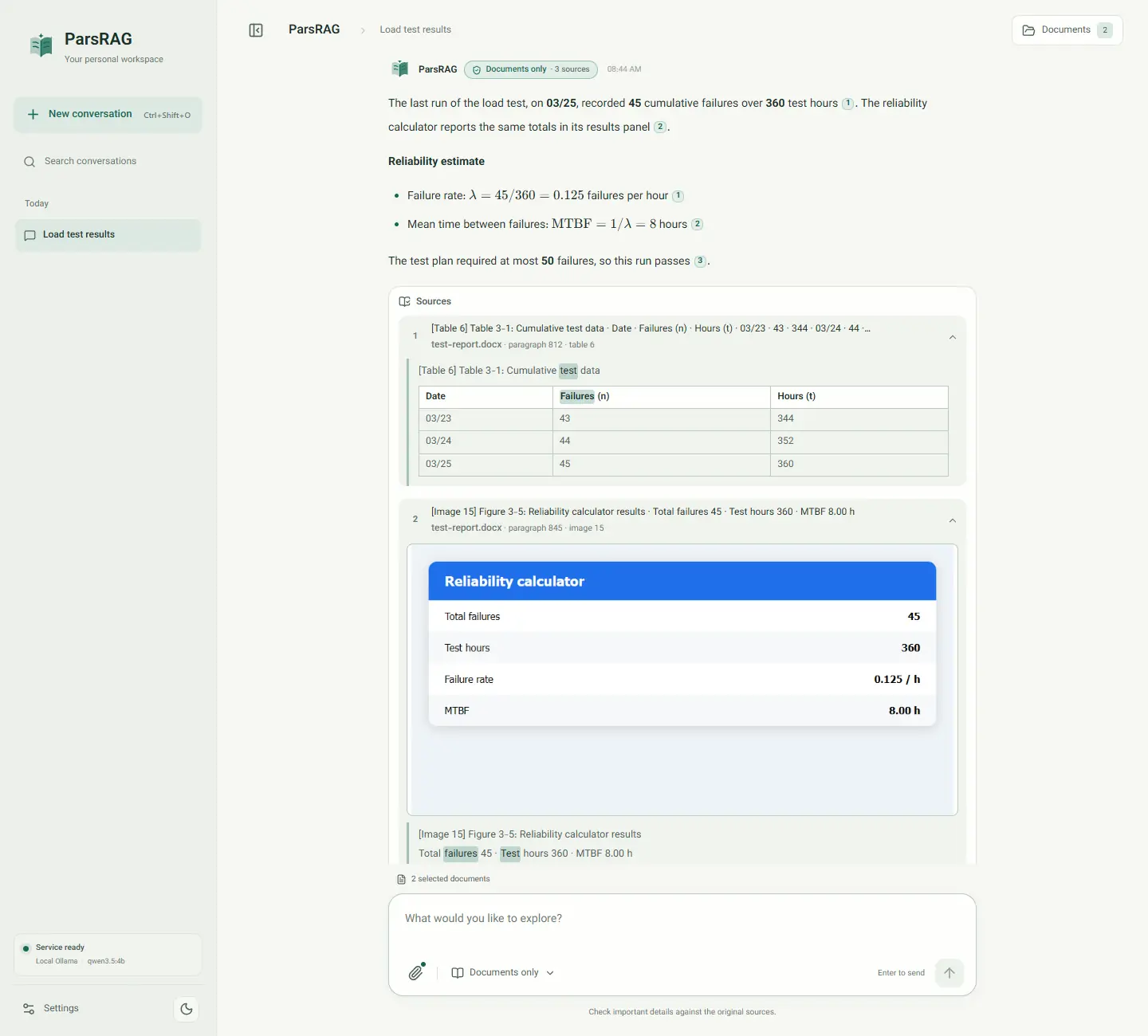
- The model cites passages as [n]; the interface turns them into numbered chips that open the passage.
- The Sources list shows each cited passage with a short preview, file name and location, such as “paragraph 812 · table 6” or “paragraph 845 · image 15”. Expanded, it shows up to 1,600 characters with the question's words highlighted.
- Table passages render as tables, and a passage read from a picture shows the picture itself next to the text.
- Passages that were consulted but not cited fold under “more passages consulted”.
Where the answer came from
| Badge | Shown when |
|---|---|
| Documents only | A Documents only answer |
| Documents + model knowledge | A Hybrid answer |
| Model knowledge | An Open conversation answer |
| Not found in documents | The documents didn't contain an answer |
When there's no answer
| Outcome | Message |
|---|---|
| No documents matched | No relevant passage was found in this conversation's documents. Add a document or ask more specifically. |
| No evidence | The provided documents do not answer this question. Switch to Hybrid mode to let the model add general knowledge. |
| Partial evidence | Not every document you mentioned has enough evidence. Ask about each document separately or check the document names. |
Working with answers
- Copy, Try again, Copy prompt and Edit prompt. Retrying or editing adds a new version you can page through; editing a prompt starts a branch that keeps its own continuation.
- Math is rendered with KaTeX. Persian words are never typeset as math, unclosed delimiters are removed, and the math markup some Gemini models leak into answers is shown as math.
- External images in answers are not loaded.
- Errors are explained by their code, for example a password-protected PDF, a rejected API key, a model that isn't installed or an API account that is out of credit.